The Palm Pre Revealed: The Technologizer Review
It's not perfect--but it's the iPhone's most formidable rival. And maybe the most important PalmPilot since the PalmPilot.By Harry McCracken | Thursday, June 4, 2009 at 5:00 am
 Is it possible to out-iPhone the iPhone? Again and again, we’ve seen other manufacturers come up with phones that try so very hard to look and work like Apple’s blockbuster, such as this one, this one, and this one. Some beat the iPhone on specs; none has come close to matching its appeal, imagination, or sales. For all the poseurs out there, the iPhone still feels like a product in a category of one, nearly two years after it first shipped.
But maybe the way to truly rival the iPhone is to counterpunch. What if a phone ignored some of the iPhone’s most obvious virtues, choosing to zig where Apple zagged? What if it aimed to rival not the iPhone’s look and feel but its spectacular record of innovation? What if the overarching goal was to be a really good, really inventive next-generation smartphone?
What, in other words, if it were Palm’s new Pre?
Back at the Consumer Electronics Show in January, Palm unveiled the Pre with one of the most startling, sexy demos in tech history. Judging from the time I spent with a Pre this week, the phone lives up to most of its considerable promise. The hardware is quite good, but it’s the software–in the form of Palm’s webOS, the long-awaited successor to the groundbreaking-but-obsolete Palm OS–that makes the Pre so special. And the combination of the two is enough to catapult the Pre into a two-phone race with the iPhone 3G. (I suspect that one or more Google Android phones will be in serious competition before long, but the only Android phone to ship in the U.S., T-Mobile’s G1, is behind the iPhone and Pre by a furlong or two.)
Many people will find reasons to avoid the Pre, from its price ($299, or $199 after $100 rebate with two-year contract) to the fact it launches only on the Sprint network (a Verizon version is supposedly about six months away). Still, even if you never buy one, it’s a significant product. The Pre is so solid in so many areas that I expect multiple aspects of its hardware and software niceties to influence and improve competitive products. Maybe even ones from a company in Cupertino named after a piece of fruit.
Pre Hardware
Until now, it’s been a given that any smartphone with its eyes on the iPhone would adopt a somewhat similar slablike shape. The Pre doesn’t. It’s smaller, more sculpted, and more pocketable–less like a tiny tablet computer, and more like a phone. (The form factor feels like a modernization of the one sported by Palm’s Treos; it’s that, as much or more than the software, that hints at the Pre’s distinguished lineage.)
Here’s the Pre flanked by the iPhone 3G and the Google Ion (the phone Google distributed to developers at its conference last week, a twin of T-Mobile’s upcoming G2):
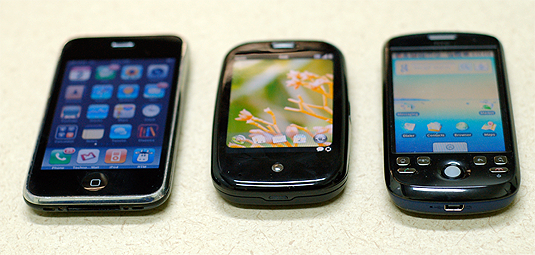
The Pre is chunky, too–mostly because a slide-out QWERTY keyboard is concealed beneath the screen. The most elegant thing about the phone from a hardware standpoint is its graceful curve when the keyboard is extended; it feels equally good against your face in either configuration.
Many will be drawn to the Pre because it has the physical keyboard that the iPhone lacks. In person, it’s strikingly cramped compared to those on RIM’s BlackBerrys, and it sits within a recessed area so that it can tuck away safely when not in use.
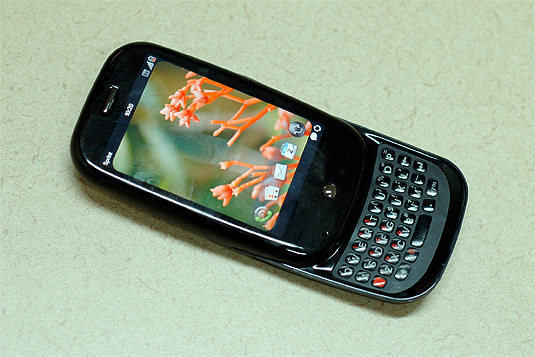
The Pre’s keys have an oddly soft, slick feel, like a painkiller in gelcap form; I assumed I wouldn’t like them. But with tiny keyboards, the proof is in the typing–and I was able to type at an adequate clip on them without making a single typo. And unlike the iPhone’s onscreen keyboard, which can seem hopelessly impossible until you get the knack, the Pre’s keyboard is immediately useful.
Then there’s the screen, which packs the same number of pixels (320-by-480) into considerably less physical real estate (3.1″ compared to 3.5″). The extra density makes it particularly gorgeous; it looks less like a piece of electronics and more like a colorful image that happens to be able to change when you touch it. Compared to the iPhone’s screen, though, it’s on the puny side when it comes to text-heavy items such as Web pages. I suspect a Pre e-book reader would be far harder on the eyeballs than Kindle for the iPhone.
The area beneath the screen is also touchable: For instance, if you swipe your finger to the left, you move back one level in whatever application you’re in. There’s a button that’s akin to the iPhone home one, plus ones for power, volume, and vibrate mode.
Some early reviews of the Pre have griped that the case is plasticky and chintzy. I found that it fell short of the iPhone’s solidity, but was as good or better than those of most of the phones I’ve owned. On the other hand, I wish that the USB connector wasn’t concealed behind a tiny door: It’s tough to flick open with your finger, and looks like it’s just begging to be accidentally snapped off.
The Pre’s storage situation–8GB of flash memory and no slot for more–is likely to be a flaw only if you plan to load up the device with a ton of music and movies. Its battery, unlike the iPhone’s, is removable; I didn’t attempt to test its life, but most reviews published so far say it’s adequate at best. (My pals at PC World rate talk time at five hours and 17 minutes in their review.) The camera has three megapixels of resolution and an LED flash, and takes somewhat better stills than an iPhone, bur doesn’t do video.
All in all, the Pre is a pleasing hunk of hardware. It’s not going to render the iPhone’s more screen-centric design obsolete, but it’s nice to Palm try something new.
1 2 3 NEXT PAGE»
19 Comments
Read more:
5 Comments For This Post
14 Trackbacks For This Post
-
A Comprehensive List Of Palm Pre Reviews (Updated 6/4) | Pre Insiders Says:
June 4th, 2009 at 10:56 am[…] PreCentral.net Slashgear Wired New York Times Cnet Engadget Gizmodo All Things D MSNBC Business Week PC World PC Mag Yahoo!Tech USA Today Wall Street Journal (Walt Mossberg) CNN Money Palm Infocenter Treonauts Technologizer […]
-
25 Features iPhone OS Still Needs | Technologizer Says:
June 17th, 2009 at 12:40 am[…] Background music for third-party apps. Once you’ve used the Palm Pre version of Pandora and streamed music in the background while doing something else useful or entertaining in the […]
-
A Pre for Under a Hundred Bucks? Good Deal! | Technologizer Says:
July 26th, 2009 at 1:54 pm[…] living up to their initial expectations. But I don’t think the 50% discount a few weeks after the Pre’s release is a sign of panic on anybody’s part. When Apple cut the price for the iPhone 3G to $99 two […]
-
Palm Ditches Windows Mobile | Technologizer Says:
September 17th, 2009 at 5:30 pm[…] today that the company won’t be making any more Windows Mobile phones–starting with the Pre and Pixi, it’s betting everything on its own WebOS. Which isn’t the least bit […]
-
An Advance Look at Android 2.0 | Technologizer Says:
October 16th, 2009 at 2:49 pm[…] match the innovation, efficiency, elegance, or ingenuity of Apple’s iPhone OS or, as seen in the Pre, Palm’s WebOS. So I’m looking forward to Android 2.0–aka […]
-
The T-Grid: Verizon Droid vs. iPhone 3GS | Technologizer Says:
October 28th, 2009 at 5:47 pm[…] See all: News So Verizon’s Droid is official, and officially arriving a week from Friday. I’m smart enough to know it’s pointless to call any phone an iPhone killer, or even a potential iPhone killer–and that competing with the iPhone is much more about software and overall integration than it is about hardware specs. (If you could kill the iPhone through trumping its specs, it would already be a goner.) But the Droid does pack better specs than the iPhone 3GS in many areas–including its screen, which has well over twice as many pixels. It runs the promising Android 2.0 OS. And it’s on a network that doesn’t provoke much in the way of squawking from its customers. In short, it’s the most formidable Google rival since the Palm Pre. […]
-
Verizon Droid: First Impressions | Technologizer Says:
October 29th, 2009 at 8:08 am[…] to the conclusion that vertically-oriented phone keyboards like the ones on BlackBerries and the Palm Pre are more usable than horizontal ones like the Droid’s, because they let you thumb-type […]
-
First impressions of Verizon’s Motorola Droid Says:
October 30th, 2009 at 6:37 am[…] to the conclusion that vertically-oriented phone keyboards like the ones on BlackBerries and the Palm Pre are more usable than horizontal ones like the Droid’s, because they let you thumb-type […]
-
Verizon Droid: First Impressions | Olive United Methodist Church Says:
November 4th, 2009 at 11:25 pm[…] to the conclusion that vertically-oriented phone keyboards like the ones on BlackBerries and the Palm Pre are more usable than horizontal ones like the Droid’s, because they let you thumb-type […]
-
Is it Too Early to Start Designing the Verizon Droid II? | Technologizer Says:
November 6th, 2009 at 2:06 am[…] the result is first Android phone that’s fully worthy of being compared to the iPhone 3GS and Palm’s Pre. (It’s most definitely an example of the class of device that Walt Mossberg calls […]
-
Apple’s Next iPhone Must Resurrect the ‘Wow’ Effect Says:
January 7th, 2010 at 1:52 am[…] innovative ideas. Initially, there were many second rate imitators, but now, products including the Palm Pre and Nexus One match if not surpass the iPhone in numerous […]
-
Palm’s Pre, Plussed: The Technologizer Review Says:
March 1st, 2010 at 1:28 pm[…] to loan me a Plus for review. Here’s my take, following up on the story I did on the original Sprint Pre back in June. Executive summary: the Pre Plus isn’t a radically different phone from its predecessor, but […]
-
My iPhone Wish List: A 4.0 Tally Says:
April 8th, 2010 at 3:45 pm[…] Background music for third-party apps. Once you’ve used the Palm Pre version of Pandora and streamed music in the background while doing something else useful or entertaining in the […]
-
Third-Party Windows Phone 7 Apps: The Early Entrants Says:
August 6th, 2010 at 12:30 pm[…] Phone 7 is out there, it’ll be a while before anyone can read its vital signs. (Hey, I was optimistic about the Palm Pre’s chances at first.) But Microsoft has a long history of being really good at making its platforms attractive […]




June 17th, 2009 at 7:24 pm
Great Review. I am rooting for Palm to get back into the game..
October 7th, 2010 at 11:09 pm
http://www.topfatlosstrainer.com/2009/09/29/megan…
this is a very great blog that the readers having an interest to visit it often
more on interesting things to follow and can give the satisfactions to the people.
thank you guise for this article.
Brad Campbell
Megan Fox workout
December 25th, 2011 at 1:16 am
I tried to combine the good parts of all the tutorials I found into one application, and one tutorial that you can see here today.
payday loans
January 4th, 2012 at 11:38 am
In person, it’s strikingly cramped compared to those on RIM’s BlackBerrys, and it sits within a recessed area so that it can tuck away safely when not in use.
juegos de sonic
January 4th, 2012 at 11:53 am
If you would be kind enough to drop a quick reply here or a message to me giving a little information on the issues you’re facing
vacuum sealer reviews