Classic PCs vs. New PCs: Their True Cost
Doing the math makes technology's relentless progress even more amazing.By Benj Edwards | Sunday, October 25, 2009 at 10:30 pm
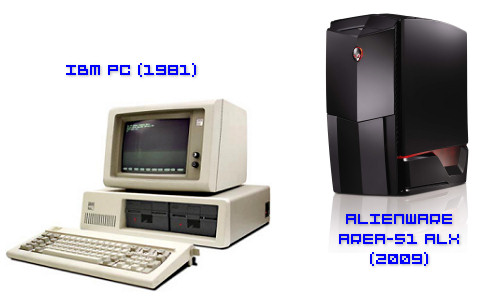
IBM PC 5150 vs. Alienware Area-51 ALX
|
Computer
|
IBM PC 5150
|
Alienware Area-51 ALX |
|---|---|---|
|
Year Sold
|
1981
|
2009
|
|
Price
(2009 Dollars) |
$7,127.69 |
$7,113.00 |
|
Price
(1981 Dollars) |
$3,000.00
|
$2,993.82
|
|
CPU Type
|
Intel 8088
|
Intel Core i7 975 Extreme Edition
|
|
CPU MHz (Total)
|
4.77
|
15,440
|
|
RAM (KB)
|
64
|
12,000,000
|
|
Fixed Disk (MB)
|
0
|
3,500,000
|
|
Removable Drive Type
|
5.25″ Floppy
|
Blu-ray Disc Burner
|
|
Removable Capacity
(KB, Per Media) |
360
|
50,050,629
|
|
Operating System
|
IBM PC DOS 1.0
|
Microsoft Windows 7 Ultimate 64-bit
|
|
Extras
|
None
|
21.5″ LCD Monitor, Dual 1.8GB NVIDIA GeForce GTX 295, 802.11n Wi-Fi card
|
In matching IBM’s first PC price-for-price, it seemed natural to look to IBM’s descendant in the desktop PC market, Lenovo, who bought IBM’s PC division back in 2005. But Lenovo’s most expensive desktop PC offering (ThinkCentre M58p Tower) maxed out at $2,343 using the company’s online configuring tools. So I looked to another source to match the PC’s inflation-adjusted $7,127 price, and Alienware’s offering fit quite nicely (notice that it includes a 21.5″ LCD monitor).
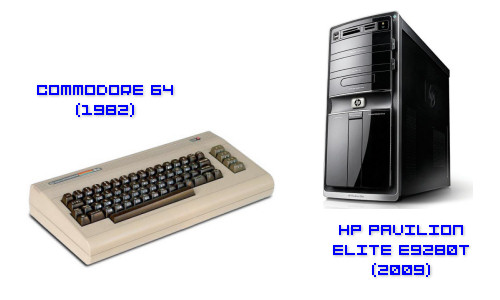
Commodore 64 vs. HP Pavilion Elite
|
Computer
|
Commodore 64
|
HP Pavilion Elite e9280t |
|---|---|---|
|
Year Sold
|
1982
|
2009
|
|
Price
(2009 Dollars) |
$1,331.62 |
$1,329.99 |
|
Price
(1982 Dollars) |
$595.00
|
$594.27
|
|
CPU Type
|
MOS 6510
|
Intel Core i7-920
|
|
CPU MHz (Total)
|
1.02
|
10,640
|
|
RAM (KB)
|
64
|
8,000,000
|
|
Fixed Disk (MB)
|
0
|
1,500,000
|
|
Removable Drive Type
|
None
|
16X DVD-ROM
|
|
Removable Capacity
(KB, Per Media) |
0
|
4,700,000
|
|
Operating System
|
Commodore BASIC 2.0
|
Microsoft Windows 7 Home Premium 64-bit
|
|
Extras
|
None
|
1GB NVIDIA GeForce GT 220 graphics card, integrated 10/100/1000 Ethernet, 15-in-1 memory card reader, TV tuner card, integrated 7.1 channel sound, multimedia keyboard, optical mouse
|
During the Commodore 64’s heyday, consumers and the media alike were impressed by the machine’s low cost, especially given its impressive 64K of memory. An aggressive price war instigated by Commodore’s Jack Tramiel fueled the C64’s rock-bottom prices, which dropped dramatically over its life span. Those prices helped make the C64 the world’s highest-selling computer model of all time.
From a modern perspective, just how cheap was the C64? It premiered for $595, which is $1,331.62 in 2009 dollars. $1,331 can buy you a very impressive PC these days, as you can see above. It’s interesting that the C64–a $1,331 computer–was considered the low-end (price wise) of the computer market in the early 1980s. Today’s low-end computers, which are still millions of times more powerful than the C64, typically retail for around $300-400 dollars.
49 Comments
Read more:
40 Comments For This Post
9 Trackbacks For This Post
-
Is Windows Overpriced? | Technologizer Says:
October 27th, 2009 at 9:57 am[…] Classic PCs vs. new PCs […]
-
Computers Just Keep Getting Cheaper and Better | Reaction Radio Says:
March 31st, 2010 at 7:01 am[…] Neumark points to a great website "Classic PCs vs. New PCs: Their True Cost Doing the math makes technology’s relentless progress even more amazing," where they […]
-
Computers Just Keep Getting Cheaper and Better | Stocks and Sectors Says:
March 31st, 2010 at 11:49 am[…] Neumark points to a great website "Classic PCs vs. New PCs: Their True Cost Doing the math makes technology’s relentless progress even more amazing," where they […]
-
Jobs Calls Out Android Over Porn — Think Geek Australia Says:
April 10th, 2010 at 8:22 pm[…] Classic PCs vs. New PCs: Their True Cost […]
-
New PCs vs. the PCs of Yesteryear | New Memory Lane Site Says:
May 12th, 2011 at 10:11 pm[…] Awesome article breaks down what you get in a computer today versus the computers of yester-year, adjusted for inflation. The results are AMAZING. Classic PCs vs. New PCs: Their True Cost […]
-
Amazon Just Destroyed the Low-End FeatureTablet Market | ZDNet Says:
September 29th, 2011 at 4:41 pm[…] guys, not Andy Grove or Steve Jobs, who do the dirty work enabling miracles like the fact that the price/performance of today’s computers are tens of thousands times greater than 25 years […]
-
Amazon Just Ruined a Huge Portion of the Tablet Market | Hold Your Future Says:
October 1st, 2011 at 12:10 pm[…] like the fact that the today’s computers cost the same as they did 25 years ago and yet […]
-
I’m dreaming of a pocket Macintosh | News all the time Says:
July 2nd, 2014 at 3:56 am[…] is that computers are becoming smaller, faster, and less power-hungry while simultaneously becoming less expensive than ever before, historically, when adjusted for inflation. As computing technology continues to shrink in size […]
-
I'm dreaming of a pocket Macintosh - Macworld Australia - Macworld Australia Says:
July 2nd, 2014 at 4:57 pm[…] is that computers are becoming smaller, faster and less power-hungry while simultaneously becoming less expensive than ever before, historically, when adjusted for inflation. As computing technology continues to shrink in size […]




October 25th, 2009 at 3:21 pm
It's amazing how computing technology advances in leaps and bounds. My first computer was a 486 with 64mb RAM. And I thought it was the greatest thing around when I got it.
October 25th, 2009 at 11:55 pm
My first was a Leading Edge Model D. About $1600 in 1988, running at 4.77 MHz. It had a 20 MB hard drive, and they had "tweaked" it to get 30 MB out of it, but it had all sorts of problems,and they ended up installing a regular 20 MB in the machine. Amberchrome monitor to top it off. That thing lasted me through graduate school….
I just started using a new Macmini, and I don't think I have done much of anything to come close to taxing it.
October 26th, 2009 at 9:05 am
My first computer was a Commodore Vic-20. It had a mind blowing 3.5 kilobytes of RAM. Including cassette tape drive, it would have cost several hundred Australian dollars back in 1982.
I am typing this on a 2009 Macbook Pro with 4 gigabytes of RAM. I reckon in 1982 it is possible there wasn’t 4 gig of RAM in all the personal computers in Australia combined.
Wow.
October 26th, 2009 at 10:12 am
Anyone want to try this for gaming systems? The original NES v. Wii? Atari v. X-Box 360? How about early PDA’s compared to the iPhone?
October 26th, 2009 at 12:08 pm
There’s a mistake on page 4: the iMac doesn’t come with a Xeon, let alone dual CPUs 😉
October 26th, 2009 at 2:00 pm
You’re right, Bouke. I fixed it — a simple copy/paste error on my part. Looks like everything else about that entry is correct.
October 26th, 2009 at 11:24 pm
Yeah, I remember many of those old classic machines – but where are the TRS-80 and Commodore PET? 🙂 It would be interesting to see some other form factor comparisons, too – Compaq Portable vs. Shuttle XPC? Data General One vs. ThinkPad? GRiD Compass vs. MacBook Pro?
October 27th, 2009 at 10:11 am
My first PC was the Ohio Scientific Challenger 1P, one of best 6502 based machines of its time. Very obsolete by todays standards but not forgotten.
October 27th, 2009 at 10:28 am
Guys, when are you going to learn that 1KB is 1024B, not 1000B?
256B is not 0.256KB. It’s 0.25. Also, 4GB is not 4,000,000KB. It’s 4,194,304 etc., etc…. HDD capacities are sometimes given in billions and trillions of bytes to trick the customers. However, it would be very impractical to make RAM chips like that.
October 28th, 2009 at 11:45 am
Lol, great comparison between technology yesterday & now. Really it cant be measured where it will be tomorrow. Lets imagine what might be the change in computers, dare to do it?
November 4th, 2009 at 4:55 pm
I’m another who started with a Vic20 with 5kb RAM (3.5kb usable with the built-in Microsoft Basic 2.0 ..that was easy to fill up.) Had a tape drive for storage (ie: standard cassette tapes.) As I recall the tape drive cost around US$100 ..a 5.25″ disk drive (128kb, single sided) cost as much as the computer! Great machine though.
As I recall, the Sinclair ZX-81, the original UK version of the Timex-1000, had only 1kb of RAM. And the CPU did *everything*.. including drawing to the screen. (32×24 characters.. pure black and white.) 🙂 In the picture shown in the article, the Timex has a whopping 16kb RAM expansion plugged into the back. Great things, but didn’t seat itself particularly firmly and could crash the machine if it moved too much.
November 5th, 2009 at 6:46 am
ok guys, lets speak about 2010. what do you expect about processor, memory module & graphics ?? lets share our expectations 🙂
November 5th, 2009 at 7:12 pm
Now come on, this isn’t fair. C= 64 cost $595 when it was the absolute cutting edge fastest thing around whereas $1330 for the HP Pavillion does not represent a huge new-tech premium.
I know for a fact that my mom… er, Santa that is… didn’t spend nearly $600 when I got my C= 64. We just didn’t have that kind of money.
How much did it cost at the rock-bottom prices Jack Tramiel’s marketing schemes brought it to? Now compare it to hardware at that price inflated to today’s dollars and it’s not quite the same picture, eh?
November 6th, 2009 at 8:47 am
Indeed things have come a long way. I practically lived through much of the home computing history. My first computer was the venerable Texas Instruments TI-99/4A (CPU: Texas Instruments TMS9900 @ 3.0 MHz; RAM: 16Kb; storage: cassette recorder and ROM cartriges, though 5.25" floppy drives were supported; Video: NTSC video output), and my first game console was the original Atari 2600 (CPU: MOS Technology 6507 @ 1.19 MHz: RAM: 128Kb; Storage: ROM Cartriges; Video: NTSC Video output).
Fast forward to today, I use a custom-built desktop PC which I'm typing on right now (CPU: Intel Core 2 Quad @ 2.43 GHz; RAM: 2GB; Storage: total fixed storage over 1TB in RAID 1 configuration, 22X Dual Layer DVD Burner; Video: NVIDIA GeForce 8600 GTS), and I have a Sony Playstation 3 as my game console (CPU: Sony/IBM/Toshiba "Cell" Processor @ 3.2 GHz; RAM: 256MB System + 256MB Video; Storage: upgradable 80GB 2.5" SATA Hard Disk, 2X Blu-Ray Drive; Video: "Reality Synthesizer" aka NVIDIA G70).
Amazing how far technology has advanced.
November 10th, 2009 at 9:48 am
The Lisa vs Mac Pro comparison floored me. FOUR 30 inch cinema displays?! LOL!
You just have to keep throwing in “stuff” to bring the price up.
overheard while preparing this article:
“Um, dude, we’re like $5000 short of the adjusted price target.”
“Max out the RAM.”
“Already is. So are the hard drives, burners, and video cards.”
“Hmm…Give it a bigger display.”
“It’s already got Apple’s top of the line Cinema display.”
“Only one? We’ve got four graphics cards, give it four displays!”
“We’re close now, but still not quite there.”
“Throw in one more video card. I don;t know what we’ll do with it, but just throw it in there.”
November 11th, 2009 at 7:39 am
Nit: Your numbers for RAM are incorrect. 1K = 1024 bytes, not 1000. 1MB = 1024*1024=1048576. 256 bytes = 0.25 KB, not 0.256 KB.
Unfortunately, your numbers are “correct” for disk size, as somehow the hard disk industry has made 1k = 1000 a standard.
Aside from the nit, these are very interesting comparisons. I had no idea the Apple Lisa was as expensive as that back then!
November 11th, 2009 at 1:48 pm
My first computer was an Atari XL running TOS. I forget how much RAM it had but it was far less than a pimple of the a** of what we use today. My first hard drive was for an Atari ST and I believe it was 5 megs and it cost me around 5000 bucks. All my friends were green with jealousy and at that price thought it was a steal (!). When I finally went PC it was a 486/DX and man I was rockin’ at the Ritz then! For two grand it had all the bells and whistles with Windows 3.1. Woohoo!
Man have we come on long way baby!
November 11th, 2009 at 1:49 pm
Oops! That would be 500 bucks, not 5000.
November 11th, 2009 at 3:20 pm
My first pc was a Xerox 820. I don’t remember the specs. other than it had dual 8 inch floppies and CPM was the operating system. Wordstar was the word processor and Supercalc was the spreadsheet program, all on floppies. Extra was the 300 baud modem. I got the system at Goodwill for $50. It was over $5000 when new.
November 12th, 2009 at 12:14 pm
Actually, although I hate to admit this… their numbers ARE correct. ISO standards now specify that “kilo,” “mega,” “giga,” et cetera, refer to powers of ten, while “kibi,” “mebi,” “gibi,” et cetera, refer to powers of two. So a kilobyte (kB) is 1000 bytes, and a kibibyte (kiB) is 1024 bytes.
Yes, it sounds ridiculous, and yes, nobody actually uses the things, but *technically* they are correct.
November 15th, 2009 at 2:14 am
It might be interesting to compare a current laptop to a state of the art mainframe computer of the late 60’s.
The first computer that I used was a Control Data Corporation 6400. The hardware took up three climate controlled rooms with halon fire suppression and required a full-time staff of at least three people to maintain the central processing unit and the refrigerator sized tape drives. Programming code was entered (one line at a time) on punched cards prepared on a keypunch machine that weighed as much as an average linebacker. Results were printed out on a dot matrix printer the size of six old fashioned manual typewriters combined and just as noisy.
The first “simple” program that I ever wrote used over 1500 punch cards and needed four revisions before it would even run.
So where is the comparison? Well, that stack of punchcards was twice the size and three times the weight of my laptop.
Seriously, there is no comparison. That was a different world with different technology and different expectations.
November 15th, 2009 at 9:24 pm
I got my first home computer in 1983, an Atari 800 for which I spent $550. It used the Moto 6502 chip running at a full 2 MHz (the Commodore and Apple 6502 machines ran just slightly under 2 MHz) and had 48 KB of user available RAM. It didn’t come with a floppy (that was an add-on extra) but it did have a tape storage drive. It took a full 15 minutes to load in the game Zaxxon from tape to memory.
In 1985, I moved up to an Atari ST, for which I spent $800. It used a Moto 68000 chip running at 8 MHz (interestingly enough, the Commodore and Apple 68000 machines ran slightly under 8 MHz) and had 512 KB of available RAM. It came with a built in 3.5″ floppy drive. A year later I added a homemade external 5 MB hard drive for $500. Those were fun times.
January 1st, 2010 at 8:31 am
do you forget to mention that the Atari 1040ST was the first machine whit the ratio 1KB < $1
do you no mention any other Amiga model :(, the Amiga 1000 was the first one, but one favorite was the Amiga 2000/3000/4000AGA with VideoToaster card for video edition … or the Amiga 500 that come closer to the C64 record to be the most selled computer in the world … until the same commodore killed the product :/.
my first PC was an Atari800XL with SpartaDOS …. i was going to buy an Atari ST, but instead, bought an Commodore 128 with several extras (2 5 1/4 drives, mouse, 512KB Ram expansion) and after this, my beloved Amiga 1200 … my first x86 PC was to install and run Amithlon, the system to run AmigaOS almost natively in x86 PC (killed for another set of stupid companies related to Amiga 🙁 )
January 21st, 2010 at 2:40 pm
Guys – a bit off topic, but your conversion argument (1kb = 1024 bytes) reminds me of a discussion I heard a while back between a sales rep and a disgruntled customer, both of whom were completely oblivious to any technical knowledge. (note the item purchased was used, but certified like new)
Customer: I bought this XBox 360 with a 120GB hard drive, and when I turn it on, the system says there is only 91 GB available on the hard drive
Salesman: Well the Xbox Operating system takes up some space on the drive
Customer: But I paid for 120GB of space, you must have given me a faulty one, I want a new one with all the space on it
Salesman: I’ll be glad to replace it if you are not satisfied, but lets test the new one to make sure.
…Salesman picks up a different HDD module for the Xbox360, walks over to their demo machine, which is up and running fine with no HDD in it, turns it off, plugs in the HDD, boots it up, and checks the HDD capacity… System states 91GB
Customer: Well whatdoyaknow, the XBOX operating system does take up space on the drive. What a rippoff.
January 26th, 2010 at 3:58 am
It was frustrating for me, a 70’s teen, to see that home computers were out there, and knowing that I could never afford them. Finally, in 1993, I got a 486-66 setup for 1500 bucks. Now, I have several PC’s with various operating systems all networked and sharing a 2 meg internet connection. I have a ten-year-old Dell GX-1 backup server with mirrored drives that cost me 25 bucks. What a great time to be alive!
February 24th, 2010 at 5:23 pm
I wrote the following about the PCjr in a comment on your Fifteen Classic PC Design Mistakes article before I even read the Classic PCs vs. New PCs: Their True Cost:
… These add-ons and modifications (of a PCjr) gave me a 640K, 2 floppy, 104 key wired keyboard system for about $750. Sure it wasn’t very elegant (a couple sidecars for instance) but it worked fine especially for the money. Around the same time –1983 or 4, I used my IBM employee discount to save my dad some money on the purchase of a real IBM PC. This 256K 2 floppy system still cost over $2000 and that was with a 50% employee discount. PCs cost a LOT MORE back then, adjusting for inflation you could at least double the dollar amounts to get current equivalents. So taking in to account inflation and my discount today’s equivalent would be $8000, with that you could buy a super high-end giant monitor and hard drives (including a SSD), dual graphic card, ultra fast gaming system. …
Using this article’s more accurate inflation figures gives me $9,504 instead of $8000 to spend. I went to the Alienware web page and configured this system for $9,482:
Overclocked Intel Core i7 975 3.86GHz (8MB Cache)
Alienware Area-51 ALX + TactX Headset
Genuine Windows 7 Ultimate, 64bit, English
Dual 2GB GDDR5 ATI Radeon HD 5970 CrossfireXEnabled
12GB DDR3 1333MHz (3x 4GB) Tri Channel Memory
512GB RAID 0 (2x 256GB Solid State Drive)
1.5TB RAID 1 (2x 1.5TB SATA-II, 7,200 RPM, 32MB Cache
Creative Sound Blaster X-Fi Titanium
Logitech Performance Mouse MX
Logitech Cordless Desktop MX 5500 Revolution Keyboard
6X Blu-ray) Burner and 24x CD/DVD Burner (DVD+/-RW)
Dell 3008WFP 30 inch UltraSharp Widescreen Digital
19-in-1 Media Card Reader
Logitech Cordless Rumblepad 2
I selected the most expensive component in every category except the following:
No PCIe slots available to add better wireless or TV tuner. Went with higher capacity (1.5TB) rather than faster rpm (10K) and lower capacity (300G) on second hard drive setup, which would have been $150 more. Didn’t add $200 flight sim controller or $80 gameboard.
I’m more of a Audio/Video guy than a gamer (Could become one with this outrageous system) so I would be more than happy with much less expensive video card like the ATI All-IN-Wonder HD with an additional USB TV Tuner. A 30-inch monitor wouldn’t fit in my computer cabinet and seems almost too large. Anyway this is super system compared to what you got in the 80s.
March 22nd, 2010 at 8:36 pm
> Guys, when are you going to learn that 1KB is 1024B, not 1000B?
No, that’s no longer true. The traditional binary-based computing measurements have been standardized in decimal, just like all the other standardized measurements. The computer measurements have grown up, so to speak. You can see this change reflected in capacities of solid state storage and in Mac OS Snow Leopard.
1 kilobyte is indeed 1000 bytes, just like 1 kilometer is 1000 meters. If you want to refer to 1024 bytes, that is a kibibyte. 1024 kibibytes is a mebibyte, and 1024 mebibytes is a gibibyte. Cute words, huh? The traditional kilobyte, megabyte, gigabyte, and petabyte and so on are all decimal-based now: 1000 inside each of them. 1000 gigabytes is a terabyte.
http://en.wikipedia.org/wiki/Kilobyte
March 31st, 2010 at 7:54 am
Yo – this is an invalid comparison. As you can clearly see, the Timex Sinclair has the 16KB memory extender pack added. So, it’s 16KB, not 1KB!
April 28th, 2010 at 4:34 pm
Hmm, judging from the title, I expected actual technical comparison. With price breakdown for most important components and maybe even profit margin estimation. Instead, you research work mostly amounts to USD inflation adjustments.
BTW, my first PCs were soviet Sinclair ZX Spectrum clones, x86 PCs and Yamaha MSX-2 at school. Also BK0010, PDP-11 – based microcomputer.
P.S. Sorry for bad english
P.P.S. Anyone wants to compare responsiveness of early PCs with laggy modern operating systems?
August 5th, 2010 at 4:07 pm
One other thing to take into account is wages which don't necessarily follow inflation. Spending $4000 1980 dollars might have been easier than spending the equivalent in 2009.
April 27th, 2011 at 7:02 am
The equivalent today is ~$17,000. The last 2 years have been VERY hard on wages.
July 25th, 2011 at 1:16 pm
Fantastic experience, I'm glad these are coming out well. Orlando Furniture Stores
August 25th, 2011 at 6:21 am
Thank you for the sensible critique. Me and my neighbor were just preparing to do a little research about this. We got a grab a book from our area library but I think I learned more from this post. I’m very glad to see such wonderful info being shared freely out there.
August 29th, 2011 at 1:46 am
A very good and informative article indeed . It helps me a lot to enhance my knowledge, I really like the way the writer presented his views. ebooks with resale rights | custom home builders
September 24th, 2011 at 10:14 am
WOW, very interesting post! I remember when I bought my first PC, it was a 386 and for me it was super advanced!
September 24th, 2011 at 6:30 pm
LOL, we had a mac plus, and spent nearly $10,000 on an external hard drive of 20MB, that's MEGAbytes, not GIGABytes. Damn thing sounded like a plane taking off as well!
Aquariums Adelaide
October 14th, 2011 at 6:00 am
Thanks for sharing! PC Prices have been staying the same for the last couple of years. Although new technology comes out, I think we will see the base price of a PC remain around what it is for a while. I don't see them possibly getting any cheaper.
January 12th, 2012 at 9:41 am
It's amazing how computing technology changes. I remember when my computer finally had 1GB of HD space. thought it was the greatest thing in the world….
January 12th, 2012 at 9:42 am
It's amazing how computing technology changes. I remember when my computer finally had 1GB of HD space. thought it was the greatest thing in the world….
January 13th, 2012 at 10:14 pm
Given that modern PCs have more grunt than the mainframes of 30 years ago, it's no wonder that we're partitioning these "low end" systems in much the same way we partitioned mainframes.