
Think that Ultrabooks–which generally go from $900 to $1400–are too pricey? AMD wants to bring the price down to $800, says Digitimes’ Monica Chen. (Machines based on its chips will have to be called something other than “Ultrabooks,” though–that’s Intel’s moniker.)
Tag Archives | AMD
AMD Goes the Open Route With HD3D
 AMD thinks the best way to assemble a stereoscopic 3D PC gaming rig is to pick all the parts yourself.
To that end, the chipmaker is launching HD3D, an answer to NVidia’s 3D Vision technology that takes an open approach to software and hardware support. AMD already supports 3D in some of its graphics cards, but HD3D is more of a philosophy for how AMD will treat the technology. And for the most part, that philosophy comes down to the kind of glasses you’ll use.
No comments
Less Annoying Laptop Stickers from AMD
Forget the iPods and Apple TV; David Pogue has the best news I’ve heard all week: Starting next year, AMD will make the stickers it slaps on laptop palm rests considerably less annoying to remove. They’ll peel off easily and leave no sticky gunk behind. Maybe other companies will follow suit, or better yet, get rid of those ugly advertisements altogether.
2 comments
New HP Notebooks: Envy Updates, Posher Pavilions, AMD (Almost) Everywhere
HP announced scads of new notebooks today. I’m not going to try and cover every detail on every model. But here are a few notes on items I found interesting. (I was briefed by the company and saw the new systems in person.)
3 comments
Apple-AMD Rumor
AMD CPUs inside Apple computers? I’ll believe it when I see it. Even if the two companies are talking, it doesn’t mean much. (Wouldn’t Apple be nuts not to explore its processor options from time to time, especially when it’s negotiating future plans with Intel?) I’d love to see it happen, though–if nothing else it would be an entertaining news story to cover…
3 comments
The FTC Sues Intel
Last month, Intel and AMD settled their differences with an agreement that ended the long-running legal battle between the world’s largest CPU maker and its much smaller rival. Today, Intel is in hot water with an organization far more powerful than AMD: the Federal Trade Commission. The FTC is suing the company, accusing it of abusing its dominating market position to stifle competion. And the most interesting parts of the FTC’s list of complaints involve not CPUs but GPUs. Which is not a market that Intel controls in the least–Nvidia and AMD dominate discrete graphics, and Intel was recently forced to indefinitely delay its Larrabee GPU. But the FTC says that Intel makes it difficult for PC manufacturers to choose Nvidia or AMD graphics options by charging them higher prices for CPUs than if they opt for Intel’s less powerful integrated graphics.
Here’s Intel’s response to the suit, in which it says it was on the verge of a settlement with the FTC, and that it’s the victim of a rush to judgment.
I don’t know enough about the backstory to have an opinion of the specifics of the FTC’s charges, and I like free markets more than government interference, but this I know: Consumers benefit when there are multiple healthy competitors in a category. If PC manufacturers make technology decisions based primarily on fear of Intel–which is what the FTC claims–it’s not good for anybody except Intel.
2 comments
Intel and AMD Declare a Truce of Sorts
 One of the longest-running, fiercest battles in tech isn’t exactly ending–but it’s sure entering a new phase. Today, Intel and AMD announced that they’ve reached a settlement that ends their legal wrangling (most notably AMD’s lawsuit against Intel for monopoly abuse), establishes a patent cross-licensing agreement, sets ground rules for how Intel can compete with AMD, and puts $1.25 billion of Intel’s money in AMD’s pockets.
The agreement doesn’t end legal action against Intel by government officials, such as the EU’s $1.45 billion fine for abusive business practices (which Intel is appealing) or New York State’s recently-filed lawsuit.
For consumers, the major question about the settlement is pretty simple: Does it increase the likelihood of healthy competition between Intel and AMD, thereby driving greater chip innovation and lower prices so that we get the most PC possible for our money? We’ll see. But it’s fascinating to look at what Intel has agreed to refrain from doing, as reported by Cnet:
• Offering inducements to customers in exchange for their agreement to buy all of their microprocessor needs from Intel, whether on a geographic, market segment, or any other basis
• Offering inducements to customers in exchange for their agreement to limit or delay their purchase of microprocessors from AMD, whether on a geographic, market segment, or any other basis
• Offering inducements to customers in exchange for their agreement to limit their engagement with AMD or their promotion or distribution of products containing AMD microprocessors, whether on a geographic, channel, market segment, or any other basis
• Offering inducements to customers in exchange for their agreement to abstain from or delay their participation in AMD product launches, announcements, advertising, or other promotional activities
• Offering inducements to customers or others to delay or forebear in the development or release of computer systems or platforms containing AMD microprocessors, whether on a geographic, market segment, or any other basis
• Offering inducements to retailers or distributors to limit or delay their purchase or distribution of computer systems or platforms containing AMD microprocessors, whether on a geographic, market segment, or any other basis
• Withholding any benefit or threatening retaliation against anyone for their refusal to enter into a prohibited arrangement such as the ones listed above.
Basically, Intel’s agreeing not to take actions that would shut AMD out of dealing with major PC companies entirely, or hobble it so severely that it might as well be shut out. Sounds good to me. I wanna have the opportunity to choose between PCs based on a variety of processors from multiple companies.
Ultimately, AMD has always fared best when its portfolio of chips has been at its strongest in comparison to Intel’s offerings. Today’s agreement won’t have any immediate effect on its product lineup, of course. But if it increases the chances that a great AMD chip will get a great response from the industry, it would be…great.
2 comments
AMD Keeps It Simple. Very Simple.
For as long as I can remember, AMD has been trying to convince the world to worry less about specsmanship when thinking about the CPUs inside PCs. It’s often had a point, such as when it argued that processor clockspeeds were a lousy way to judge a chip’s performance. (It largely won that war when Intel deemphasized clockspeeds in its marketing, although I have a sneaking suspicion that consumers still use them as a primary means of comparing processors.)
Now AMD is making a dramatic bid to simplify branding of its CPUs down to the bare essentials. In fact, rather than emphasizing specific CPUs at all, it will focus on three levels of performance:
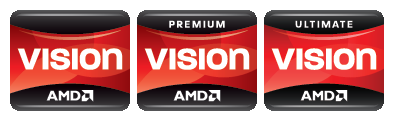
PCs with Vision technology are basic machines designed for Web browsing, music listening, and the like. Ones with Vision Premium are potent enough to handle video and audio conversion well, as well as gaming. And Vision Ultimate indicates that a PC is well suited to video recording, audio editing, advanced photo editing, and the like.
Beyond the fancy stickers, there are two simple ideas here: AMD is emphasizing media applications (which makes sense, since video and audio-related performance is the main reason to worry about what chip you get at all) and is giving consumers the classic choice between good, better, and best. (However, it plans to introduce Vision Black, a sort of “bester” designation aimed at gamers and enthusiasts, early next year.)
Intel, meanwhile, is trying to simplify performance comparisons, too–but its menu of choices is broader and more complicated, and it’s not always easy to figure out how everything relates. Which brings up an issue with Vision that’s out of AMD’s control: The most important CPU comparisons are those you make between processors from competing companies, and it isn’t obvious how the three Vision options map to Intel’s chip family.
I’m sure that serious tech enthusiasts will squawk that AMD is dumbing things down too much (and the company does say that it’ll use more traditional, meaty technical facts to market its chips and technology for that crowd). But when I think about how I buy PCs these days, the Vision distinctions would probably do the trick. There was a time when I dithered over whether I needed a CPU with a math coprocessor, and got excited over stuff like MMX extensions. Today, I mostly want a general idea of whether the processor will be potent enough for the tasks I’m likely to throw at it. And once I’ve plunked down my money for a computer, I tend to forget what’s inside.
How much time do you spend thinking about CPUs these days?
10 comments
Your Questions, AMD’s Answers
 [A NOTE FROM HARRY: Here’s the inaugural edition of a new feature: Technologizer Q&A. We’ll give you the opportunity to pose questions to interesting technology companies. First up is chipmaker AMD–many thanks to VP of Advanced Marketing Pat Moorhead for answering these queries.
Got nominations for other companies you’d like answers from? Let me know–I’m lining up subjects for future installments.]
Fernando Garcia asks:
I have always asked the following question. Why is it that AMD will not step up advertising? A good 70% of the consumer public,still does not know what AMD is. I used to work for Best Buy and on the average day, one out of eight persons I would speak to knew what AMD was. Whenever I asked a customer about processors automatically they would say Intel.
Pat answers:
Simply taking out more advertising does not guarantee a product’s success. I think the best way to answer that is AMD chooses to focus differently. We first focus on making our customers and their channel partners successful by investing in them, not leveraging off their brandsby sandwiching them between AMD logos. We want to invest in our customers’ success. For those people who are specifically focused on the “processor,” we have very high awareness and market directly to end user groups. These include but are not limited to enthusiasts, gamers, DIYers, Fortune 1000 and government decision makers, etc.
2 comments
Last Call: Got Any Questions for AMD?
 Technologizer is launching a series in which we’ll let readers pose questions to tech companies, and AMD was nice enough to volunteer to be the first organization to field your queries. Got any questions about the company, its products, the chip industry, or tech in general? Ask away in comments on this post by the end of day on Wednesday. Then look for AMD’s answers soon.