
Apple has released (through the Mac App Store) a beta version of OS X 10.7 Lion to paid members of its Mac developer program–tangible evidence that the upgrade is on schedule for summer release. The OS upgrade focuses on features inspired by the iPad, such as a full-screen mode, more use of gestures, a Launchpad that looks like the iPad’s home screen, and Mission Control, which melds together the existing Exposé, Spaces, and Dashboard features. It also lets apps incorporate auto-save modes, has a new version of the Mail app, adds a no-configuration-required file-sharing feature called AirDrop, and more.
Tag Archives | Apple Macintosh
So How Was Macworld This Year?
 I had fun speaking at Macworld about the future of the mobile market last Wednesday. (Below, for no particular reason other than that I like it, is an image from my presentation–making the point that Android is less like Windows and more like Linux–actually, it is Linux under the skin.) I had even more fun listening to the guy who spoke after me–Bill Atkinson, who was one of the principal creators of the Mac in the early 1980s and who’s now (among other things) an iPhone developer. And I enjoyed walking the show floor Thursday morning.
When Apple announced in December of 2008 that it was puling out of Macworld, there were plenty of folks who predicted that the show would be dead within a year or two. And it did go through a great downsizing in 2010–but it may have found a new, more modest equilibrium. The show had 270 exhibitors this year and conference organizer IDG says it went into the event expecting 25,000 attendees; last year’s edition had “over” 250 exhibitors and “more than” 20,000 attendees. (The 2009 show, the last that Apple was present for, had 400 exhibitors and more than 28,000 attendees.)
No comments
Pixelmator's Million-Dollar Mac App Store Results
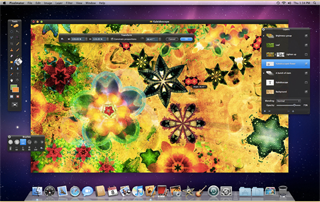 How well can a small software company do on Apple’s new Mac App Store? Very well indeed, if the results reported by the developers of Pixelmator, an image editor, are any indication.
They say that the app grossed a million dollars in sales in the App Store’s first twenty days. The program sells for $29.99 (a limited-time discount from the normal price of $59), so that’s more than 33,000 copies. The Pixelmator folks will net $700,000; Apple will keep $300,000 as its cut.
7 comments
Confessions of an Operating-System Agnostic
[NOTE: Here’s a story from our most recent Technologizer’s T-Week newsletter–go here to sign up to receive it each Friday. You’ll get original stuff that won’t show up on the site until later, if at all.]
 Whenever I write about the pros and cons of Windows PCs and Macs–as I did recently for TIME.com–I make at least brief mention of the fact that I’m a happy user of both. But I’m not sure if I’ve ever outlined just why I buy and use both flavors of computer rather than settling on one or the other. Here are some quick thoughts on that subject.
First, a review of my life as a user of operating systems might be in order. For most of it, I was a single-OS user–sometimes ardently so…
1978-1982: I was a Radio Shack TRS-80 snob (thinking back, that sounds like an oxymoron, but trust me–I was one).
1982-1984 or thereabouts: I had and liked an Atari 400, but I don’t recall being passionate about it. I also backslid and did a fair percentage of my college work on…typewriters.
1984-1986: I went through an odd period during which I temporarily lost interest in computers, except for word processing.
1987-1991: I dabbled on a borrowed Mac, but I also bought a Commodore Amiga and became a–I try to avoid this word, but it’s the only one that fits–fanboy.
16 comments
Apple's Mac Store is a Go. And the Mac is a PC
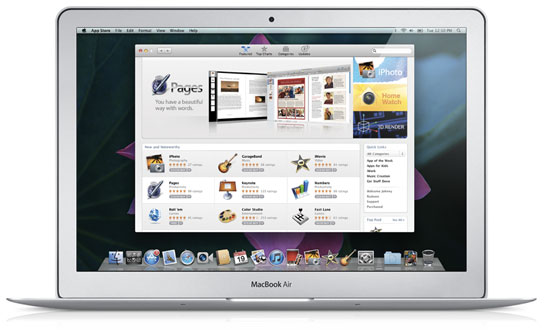 Apple has announced that its Mac App Store will open for business on January 6th. It’s a close counterpart to the iPhone App Store–easy app discovery, downloads, installs, and uninstalls, and a deal that gives developers 70 percent of the profits. But the dynamics of the business may be quite different given that the Mac Store will be an additional way to acquire apps rather than the only official one. I’m reserving judgement on how big a deal it’ll be. (Actually, I’m not even sure how much I’ll use it, let alone the rest of the world.)
Apple’s announcement about the launch included the following Steve Jobs quote:
The App Store revolutionized mobile apps,” said Steve Jobs, Apple’s CEO. “We hope to do the same for PC apps with the Mac App Store by making finding and buying PC apps easy and fun. We can’t wait to get started on January 6.
This isn’t the first time that Jobs has referred to Macs as PCs. And it doesn’t pay to read too much into canned quotes in press releases. But it’s been my stubborn habit to call Windows-based computers “Windows PCs” for years, based on the principle that Macs are also personal computers. It’s nice to see Apple–a company that has been known to bash PCs–using the same logic. To me, it’s linguistically and technologically appropriate. And who knows–Windows users might be a tiny bit more likely to consider buying an Apple computer if they look at them as an excellent PC rather than a fundamentally different, foreign device.
(I was tempted to end this post by wondering whether Jobs’ reference to PCs was a hint that the company might release an App Store for Windows PCs. But nah, it’s not going to happen…)
6 comments
Once Again, “PC or Mac?”
My new TIME.com Technologizer column is up–it’s a quick look at the pros and cons of Macs and PCs as of late 2010. As always, I’m agnostic rather than partisan.
I talk a little bit in the piece about pricing issues, but they deserve a story of their own–the pricing comparisons I’ve done in the past are all woefully out of date. (I’ve often found that Mac pricing is reasonable compared to truly comparable PCs, but it seems high at the moment–it’s been a while since Apple has done its periodic CPU/RAM/disk bumps on most models. Time to do the math again.)
2 comments
A More Mac-Like Skype for Mac
One comment
Living With Apple’s 11.6″ MacBook Air
 I like ridiculously small notebooks. There was a time when I used a truly diminutive Fujitsu subnotebook called the Lifebook B112 as my main mobile machine. I also have a soft spot for netbooks. I’m willing to make compromises to shed weight–such as dealing with cramped keyboards, squinting at small screens, and learning to use abnormal pointing devices.
In recent years. though, I’ve tended to use laptops that were reasonably compact–13″ is my favorite–but not ridiculously small. That’s in part because I’ve used Macs as much as I have Windows laptops, and no Mac notebook has been anywhere near midget-sized. The closest Apple has gotten to tiny has been the MacBook Air, and until last week, the MacBook Air (with its 13.3″ screen) hasn’t been so much small as thin and light. All Airs up until the new models have also pretty basic in terms of specs and kind of pricey–which is why they never tempted me.
But a week and a half ago, Apple announced the first all-new Airs since the original version. The prices are lower, the specs are better, and there’s a new model with an 11.6″ display. It weighs 2.3 pounds and is .11″ at its thinnest point, making Apple’s smallest Mac portable ever–much more so than my late, lamented 12″ PowerBook, the smallest Mac I’d used until now. It also starts at a temptingly low $999. I’ve been living with one (loaned to me by Apple) since the press event.
10 comments
Office for the Mac: The Same, Only Different
 Microsoft’s Office 2011 for the Mac goes on sale today–the first version to support Office’s Ribbon interface, the first one in years with Outlook, and one that’s priced to move. The company provided me with a pre-release copy a few weeks ago, and when I’ve been using a Mac I’ve been running Office and mostly enjoying the experience. That wasn’t a given: I mostly avoided its predecessor, Office 2008, which was slow and not only lacked the Ribbon but had a floating-palette interface I actively disliked. (I was known to run a virtualized copy of Windows on Macs mostly so I could use Windows Office.)
For some people, the fact that Microsoft–a company who has been known to deride Apple’s customers as trendy spendthrifts–still makes Office for the Mac is apparently hard to reconcile. Microsoft’s press site has a story that seems designed both to reassure Apple fans that Microsoft loves them and Microsoft fans that it doesn’t love Apple fans that much.
10 comments
How Long Until Apple Does Away With Disks?
Can we all agree that Apple will be the first major computer manufacturer to stop using hard drives? I assume so, anyhow–although I’m still trying to figure out just when it’ll happen.