
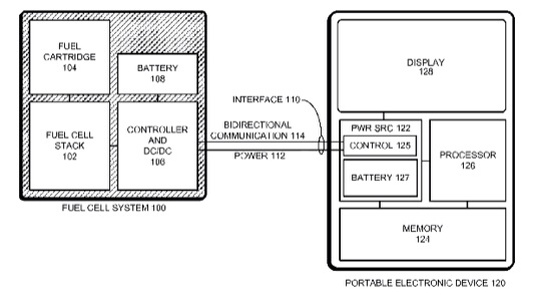
 Imagine futuristic laptops even thinner and lighter than the MacBook Air, capable of running for several days or even weeks without recharging–Apple certainly is, as a couple U.S. patents published yesterday reveal.
Tag Archives | Batteries
Is the iPhone 4S a Battery Hog?
TechCrunch’s Erick Schonfeld is unhappy with his new iPhone 4S:
Today, my iPhone died after about 8 hours—not even enough to get me through a full day without recharging (and this is typical). This was not 8 hours of constant use (unless you count the constant pinging of notifications, which may be the culprit). It was 8 hours total from the time I unplugged it in the morning and took it with me until the screen went black at around 4 PM. According to the specs, the iPhone 4S is supposed to get 200 hours of standby time, 8 hours of talk time, and “up to 6 hours” of Internet use on 3g. During the day, I made half a dozen calls less than 5 minutes each, used the Internet for an hour on the train (email, Twitter, light Web browsing), and then maybe another 90 minutes throughout the day.
Schonfeld isn’t the only person I’ve seen grumbling about this issue. Macworld’s Chris Breen has covered it, and provided some troubleshooting advice. And the Guardian’s Charles Arthur says that Apple is on the case.
How much battery life you get out of a phone is heavily dependent on how you use the phone and what you use it for–and I’m not sure if there’s such a thing as a typical user of the iPhone 4S or any other smartphone. But in my time with the iPhone 4S so far, I haven’t noticed any striking difference in battery life compared to the iPhone 4. With both phones, I can almost always get through one day, and a bit more, on one charge.
If you have an iPhone 4S and upgraded from an earlier iPhone model, have you detected a difference?
22 comments
An iPhone Battery Case That’s Also a Universal Power Pack for Portable Gadgets
 My first impulse is to compare Third Rail Mobility’s new Smart Battery and Slim Case to Mophie‘s Juice Pack, the best-known name in iPhone battery cases.Third Rail’s system does, indeed, provide an alternative way to extend an iPhone 4’s battery life. But this clever system goes way beyond that. I tried a review unit provided by the company.
The case itself looks pretty much like any nice two-piece snap-on black iPhone 4 case, except:
- The section below the dock connector is a bit taller than usual and sports a Micro USB connector;
- There’s an area on the back with electrical contacts.
The contacts on the case’s back are there because you can connect the battery there like a backpack. It’s a 1250 MaH unit, so it should come close to doubling the standard life of the iPhone’s own 1420 MaH battery. You can simply use the phone with the battery in place–it looks a little strange, but I found it comfortable enough in the hand–or attach the battery only when you need it, such as when the iPhone’s own battery is about to croak.
3 comments
Pssst: Batteries Are a Commodity
Which batteries should you buy? DealNews did some scientific testing and says that the answer is easy: the cheapest ones. (There is one exception.)
No comments
Energizer’s Inductive Charger: Qi Makes Its Debut
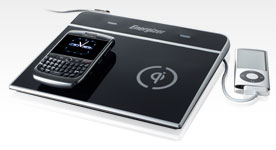 A couple of weeks ago, Ed was impressed by a demo of Energizer’s new Inductive Charger, which lets you charge phones by plopping them on a mat rather than plugging in a cable. The gadget’s about to go on sale in Target stores; Energizer loaned me a unit to try, and I’m impressed, too.
Actually, what I’m impressed by is the fact that Energizer’s system is based on Qi, a new standard for inductive charging. Earlier inductive setups such as Powermat are based on proprietary implementations–you have to buy the mat and the sleeves and replacement battery covers from the same company, and if no support if offered for your phone, you’re out of luck. By supporting Qi, Energizer’s mat will work with any Qi sleeve or battery cover. Eventually, if all goes according to plans, there will be phones with Qi support built right in, and the standard will work with other mobile gizmos such as cameras.
One comment
Why didn't Apple Use Rechargeable Batteries in the First Place?
 Kudos to Apple for developing a more energy efficient charger for reusable AA batteries, and introducing it today along with the new Magic Trackpad. I’d glad that the company is advancing its environmental record by making less toxic products, but at the risk of sounding overzealous– it’s about time. Apple’s stylish wireless keyboard and mice are needlessly sending heaps of batteries to the landfill.
I bought my iMac early this year, and felt awful at the idea of having to burn through disposable alkaline batteries. A plurality of fanboy friends told me that my Magic Mouse was “pretty awesome,” but “ate up” its batteries. My solution was to purchase some Sanyo Nickel Metal Hydride (NiMH) batteries and the accompanying charger.
I’ve gone through at least four charge cycle for my Magic Mouse; the keyboard batteries only had to be recharged once. Had I not taken it upon myself to be more environmentally responsible, they would be at least as many batteries sent to wherever Manhattan’s trash goes. My question is: Why didn’t Apple use rechargeable batteries in the first place?
Most of Apple’s customers wouldn’t have minded paying a few more dollars in their Mac’s sticker price. Apple sold 3.472 million Macs last quarter. Not all of those Macs shipped with wireless peripherals–for one thing, the majority were notebooks, not desktops–but many did. While Apple could have been more forward thinking then, it has the technology now. I’d like to see it begin to bundle greener batteries with its products.
6 comments
USB Chargeable Batteries?
 These days you can seemingly get just about anything that operates off your USB port, from USB-powered coffee warmers to — well, this is a family site so we’ll stop there. Anyways, Moixa’s USBCell batteries are one of those items: they’re AA batteries which charge off of an available USB port on your computer.
At first glance, these batteries look like any other, just with neon green caps. But that cap pops off, revealing a USB plug which is inserted into the port on your computer. Charging takes a little bit of time — about five hours or so, and usable time is a little less than what you’d find in typical rechargable batteries, probably because of the smaller capacity.
(USBCells have a 1300mAh capacity — whereas these Nickel Metal Hydride batteries from RadioShack have a 2500mAh capacity. Obviously the latter batteries are going to last twice as long.)
Interesting concept though, and I’d think probably good for those emergency situations when you need some extra battery power. The batteries come in a pack of two and retail for about $15.
No comments
InstaLoad: No-Wrong-Way Batteries From…Microsoft?
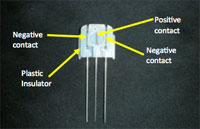 Here’s evidence of just how diversified an outfit Microsoft is: Today, it announced InstaLoad, a technology that allows devices to be built that can accept batteries in either orientation, so you don’t need to worry about whether you’ve stuck a battery into the compartment with the positive end touching the positive contact. The basic idea looks both clever and pretty simple: It’s a contact unit that incorporates both a positive contact and a negative one.
Microsoft has signed up a bunch of third parties to endorse the technology, and intends to license it for use by other manufacturers. (It’ll license it for free for use in products for disabled people who might have particular difficulty with standard battery compartments.) Oddly enough, it’s not making any announcements regarding using InstaLoad in its own products which could benefit from it, such as mice and keyboards.
4 comments
Why Your Notebook Battery Life Never Quite Seems Equal to the Claims
[A NOTE FROM HARRY: Please welcome Patrick Moorhead of AMD to Technologizer’s roster of contributors. He’ll be writing both topics relating to his day job and others that simply stem from his experiences as a gadget enthusiast.]
Do you ever feel like the actual battery life on your notebook never quite equals the information that appears in promotional material? For example, you may see “up to five hours,” but actually get about half that. Well, you aren’t alone. I hear it all the time, and if you do a quick Twitter search on the topic, you’ll see lots of discussion.
I can assure you that no devious plot exists to mislead you. It really comes down to a few simple factors.
#1: Measurements are best case: Like a car’s “highway miles per gallon” which gauges the best case (cruising at a sustained speed for an extended period without stop-and-go driving), notebook battery life is typically based on MobileMark 2007. This benchmark primarily measures battery life while the notebook is doing nothing–not even wirelessly connecting to the Internet. A “city-driving” equivalent of notebook battery life doesn’t exist…yet.
#2: Different strokes for different folks: We all use notebooks differently, and therefore will see different battery durations. Some watch HD web videos on YouTube, some may just do email, and some play more games than others. all of which will mean varying battery life. You can see this data from AMD here that shows the phenomenon. (Disclosure: I work for AMD) This also shows that battery life varies depending on the combination of components inside a machine.
#3: Battery life varies over time: The longer you own your notebook, use it, charge, and recharge, over and over again, the more the battery loses its effectiveness. So theoretically, your longest battery life will be on the first day you crack open the packaging. See all the people selling new batteries for old notebooks? Some even say that battery life is variable with heat.
So what should you do?
- Grade battery life on a curve–let’s say, 60% of the claimed performance. If the label says 10 hours, my guess is it’s probably only about 6 hours in real use.
- Ask your retailer and systems providers to provide the “city miles per gallon,” or, using the tried and tested cellphone analogy, “talk-time.” They all have Web sites–and when all else fails, you can ask them over Twitter.
I may have not added back 40% of your battery life, but hopefully you know why you only get 60% of it!
Pat Moorhead is Vice President of Advanced Marketing at AMD. You can find him on his AMD blog, Twitter, FriendFeed, and LinkedIn. His postings are his own opinions and may not represent AMD’s positions, strategies or opinions.
5 comments
Lithium Battery Breakthrough Cuts Charge Time Down to Seconds
 Imagine that you could charge a car battery as quickly as you fill up a tank of gasoline today. Stop imagining –it has become possible. Researchers have developed a new lithium battery technology that can charge and discharge in a matter of seconds.
The journal Nature is reporting that Byoungwoo Kang and Gerbrand Ceder of the Massachusetts Institute of Technology developed a glass-like Lithium mixture for electrodes that allows a charge to be rapidly stored inside of a battery. The battery is designed so that lithium ions move more freely, moving the charge in and out of storage from cathode to electrolyte. The material also retains its capacity through charge cycles.
However, don’t expect laboratory performance at home just yet. Ars Technica has noted that the battery are not entirely compatible with today’s electric grid. For example, a cell phone battery would drawn 360W in ten seconds– for a single charge. Cue the blown circuit breakers.
I’m certain that some happy medium will be reached, and we can all look forward to more advanced batteries in our electronics. This breakthrough eliminates many of the restrictions that today’s batteries place on device manufacturers, and will should lead to more powerful mobile hardware and a greater variety of devices. It’s a big win for consumers and the industry alike.