Technologizer posts about Web browsers

Flock: Officially Dead

By  |  Posted at 12:09 pm on Tuesday, April 12, 2011

13 Comments

I regret to say that this is almost certainly the last thing I’ll ever write about Flock. There was a time when it was my favorite Web browser. But being based on the Mozilla engine turned to be tricky, and last year Flock started all over again as a Chrome variant–one which was quite different from its earlier incarnation. Even if the move was logical, it was confusing.

In January, social gaming behemoth Zynga snapped up the team behind Flock–but not the browser or the company. (Most of the stories about the buyout, including mine, inaccurately said that Zynga had acquired Flock itself.) When Flock CEO Shawn Hardin’s blog post about the news didn’t say anything about the browser surviving, it was ominous. Today, it’s official: Flock is dead.

Continue reading this story…


Read more: , ,

It’s been less than a month since Microsoft released the final version of Internet Explorer 9, but it’s already unleashing a sneak peek at IE10. As with IE9, it’s starting with a nearly interface-less “Platform Preview” that’s all about the rendering engine–and especially HTML5 support–not features.

The company isn’t saying when IE10 will ship, but if it sticks to its typical schedule it might be about a year away–which would be quick on the heels of IE9 by Microsoft standards.

Posted by Harry at 9:38 am

Comments Off

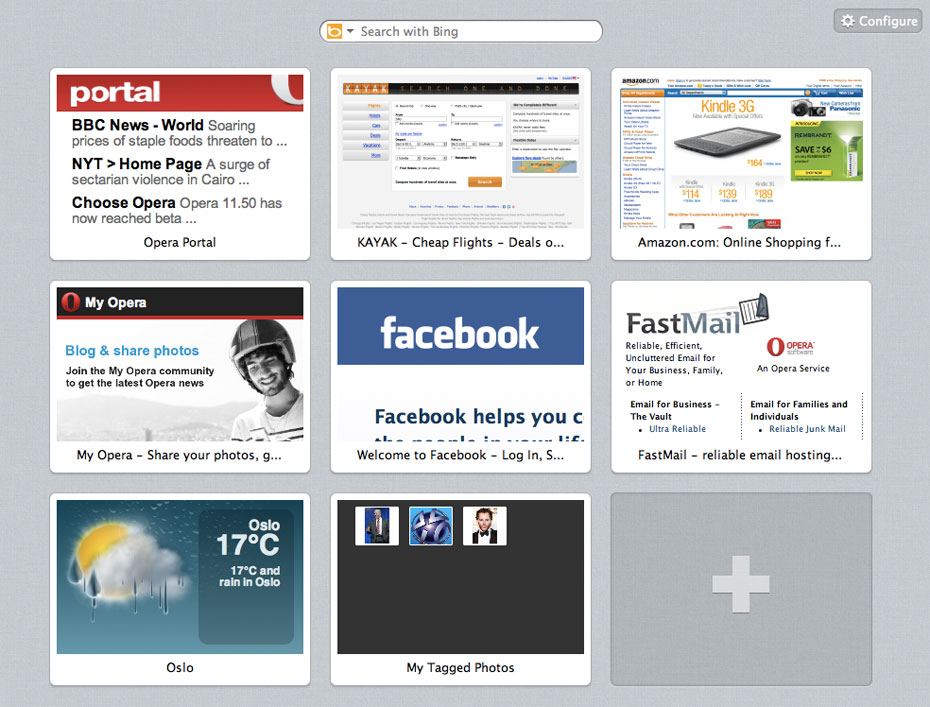
Opera has released version 11.10 of its namesake browser. It says its unique Turbo mode, which compresses Web pages on the server side before sending them to you, is now 15 percent faster. There are also some improvements to Speed Dial, the original browser “page with thumbnails of your favorite sites” feature.

Posted by Harry at 9:31 am

Comments Off

Speaking of glimpses of major software upgrades to come, Conceivably Tech has some stuff on Firefox 5.

Posted by Harry at 9:24 am

Comments Off

The Wall Street Journal’s Walt Mossberg reviews Firefox 4–favorably so, but it’s not a rave.

Posted by Harry at 8:52 am

1 Comment

Firefox for Android: Desktop-Like Browsing for Your Phone

By  |  Posted at 11:53 am on Tuesday, March 29, 2011

8 Comments

For all the rapid improvement that both Apple’s iOS and Google’s Android have seen, one thing about both mobile operating systems hasn’t changed much at all: their browsers. True, their technical underpinnings have been refined. But featurewise, they haven’t evolved at anywhere near the pace of their counterparts on PCs, where the competition among browsers is never-ending.

That’s one reason why I’m in favor of browser competition being as healthy on smartphones and tablets as it is on computers. On iOS, that’s not going to happen anytime soon–Apple doesn’t permit full-blown browsers with their own rendering engines in the App Store. (Ones that use the Safari engine, such as the excellent Atomic Web Browser, are permissible; so is Opera Mini, which does most of its work on Opera’s servers, not on your phone.) On Android, however, there’s nothing stopping other companies from competing with the OS’s built-in browser. Opera announced new versions of both Opera Mini and Opera Mobile for Android a couple of weeks ago. And now Mozilla has released the final version of Firefox 4 for Android.

Continue reading this story…


Read more: , , , ,

Chrome’s New Icon: Simpler, Homelier

By  |  Posted at 12:34 pm on Monday, March 21, 2011

6 Comments

Big news from logoland: Google has simplified Chrome’s icon. It no longer looks quite as much like Simon, but still has the world’s most popular color scheme.

“Redesigning the icon was very much a group effort,” says a post on the Chrome blog, and to my eye, that’s obvious: It looks like it was designed by a committee. Which is true to Google’s personality, I guess–but I prefer the Susan Kare approach.


Read more: , ,

Two links for you to stuff I wrote for other sites this week: My TIME.com column is about what a great a time it is to be a browser user–and why I hope the current era of harmony among browser makers gives way to more disagreement. And over at Techland, I wrote about a related question: Even if Internet Explorer 9 is good–and it is–will serious browser fans give it a chance?

Posted by Harry at 2:57 pm

Comments Off

Last night here at SxSW, Microsoft officially rolled out the shipping version of Internet Explorer 9. It’s available here for download, and very much worth checking out if you use Windows 7 (or, gasp, Vista). More thoughts soon, but it’s the best version of IE in years–and its release means that every major Web browser is a solid product. (In fact, in many ways they’re remarkably similar: Everyone’s settled on nearly identical browsers.)

If you try IE9, let us know what you think…

Posted by Harry at 7:50 am

7 Comments

Showdown: Chrome (Beta) vs. Firefox 4.0

By  |  Posted at 7:06 am on Wednesday, March 9, 2011

15 Comments

With new versions scheduled to be released for these two popular web browsers, many of us are rethinking where our loyalties lie. Should we go with the Google Chrome (Beta) or Mozilla Firefox 4.0? Is it worth the upgrade, or is it time to try something new? Here’s a list of the new and upgraded features to make your decision easier.

Release Date:

Google Chrome (Beta): Beta version available; Those using Chrome will be updated soon.

Mozilla Firefox 4.0: Web and mobile browser expected mid-to-late March. [NOTE: A beta version is available.]

Point Goes To: Chrome. It’s available now, and we all know what happens with tentative dates.

Continue reading this story…


Read more: , , , ,

Microsoft Tries Its Darndest to Bid Internet Explorer 6 Adieu

By  |  Posted at 11:22 am on Friday, March 4, 2011

9 Comments

It’s weird: In terms of durability and the sheer numbers of people who have used it, Microsoft’s Internet Explorer 6 is one of the most successful software products of all time. But between its security holes and its poor compatibility with Web standards, it’s also one of the most headache-inducing applications ever–not just for the people who use it, but for those who build sites and strive to keep the Internet safe. And in early 2011–nearly a decade after IE 6 shipped with Windows XP–it’s a product from another era. Yet NetApplications says that 12 percent of Internet users worldwide are still running it.

These days, Microsoft has at least as much reason as anyone else to try and close the books officially on the IE 6 era: It doesn’t want to support it and would prefer that IE 6 holdouts upgrade to a newer Microsoft browser running on a newer Microsoft operating system. So the company has launched an Internet 6 Countdown site, with stats on IE6′s current usage and a stated mission of driving usage down to under 1 percent.

Continue reading this story…


Read more: , ,

Internet Explorer 9 Release Candidate is Here

By  |  Posted at 1:58 pm on Thursday, February 10, 2011

1 Comment

If you’ve been curious about Internet Explorer 9 but didn’t want to mess around with earlier beta versions, now’s a good time to check it out.

The IE9 release candidate is essentially the full version of Microsoft’s new web browser. Bugs may be squashed between now and whenever Microsoft releases the final version, but all the features of IE9 are intact.  (Over at ZDNet, Ed Bott has the definitive walkthrough.) You can get the release candidate from Microsoft’s “Beauty of the Web” promotional site.

In general, I agree with Harry’s assessment that IE9 is Microsoft’s most refreshing web browser yet, even if that means looking a bit like other browsers. Although I haven’t done any fancy speed tests, I can’t think of any major reasons not to recommend IE9.

Except for one thing: A few months after Microsoft released the IE9 public beta, Google launched the Chrome Web Store, a marketplace for extensions and Chrome-optimized web apps. It’s the most significant new browser feature I’ve seen in years, in that it encourages users to customize their browsers and seek out new web-based services. Now that TweetDeck and Imo have become part of my pinned tab line-up, I can’t imagine using a browser without them.

Microsoft has embraced web apps somewhat in IE9 with the ability to pin websites to the Windows 7 taskbar, but once you’re in the browser, there’s no built-in discovery tool for useful web services, nor is there a home page from which to quickly launch them. Also, Internet Explorer’s extension library is overpopulated with feed readers and toolbars, and some of them won’t even work with IE9.

In a way, Internet Explorer is now more minimalist than Chrome, a browser that desperately wants to show you all the great things the Web has to offer. Who’d have thought it?


Read more: ,

Firefox’s Development Cycle to Get Faster

By  |  Posted at 2:45 pm on Monday, February 7, 2011

2 Comments

Likely in response to the fast-paced development of Google Chrome, Mozilla has announced it plans to accelerate the release cycle of its Firefox browser dramatically, with four major revisions of the browser expected by the end of the year. Chief among its goals are making the browser more nimble, as well as building social aspects into the platform and support for more hardware and platforms.

Seems like a solid plan considering the fragmentation of the hardware world as of late, and consumer’s increasing appetite for social networking. But I think the most important thing here is the focus on stability.

It’s no secret on some platforms Firefox is not so stable. I’ve had problems with crashing and sluggish behavior at times on Mac OS X, and have noticed others have had similar issues. Fixing these nagging issues should be a prority for Mozilla, as its competitors are more stable on Apple’s hardware.

Continue reading this story…


Read more: , ,

Lies, Damned Lies, and Market-Share Statistics

By  |  Posted at 9:27 am on Friday, January 21, 2011

2 Comments

The world of technology is rife with horse races–so much so that many tech blogs read like the Daily Racing Form. There’s PC sales vs. Mac sales. iPhone shipments vs. Android shipments. Internet Explorer usage vs. Firefox usage vs. Chrome usage. Everybody loves to keep track of who’s ahead and interpret the significance of any changes. (Including me.) The primary way that tech publications do that is by reporting on market share numbers reported by research firms and other third-party entities.

More and more, though, I’ve come to the conclusion that the good articles about tech market-share data may be outnumbered by ones that are, at best, not very enlightening. Good data gets mangled and misinterpreted; bad data gets treated like good data. Herewith, a few of the reasons why it’s so important to approach these stories with a healthy dose of skepticism.

Continue reading this story…


Read more: , ,

Just about all the discussion I’ve seen of Google’s decision to dump Chrome’s native support for video in the H.264 format has been negative–and Google didn’t help things by announcing the move in a terse, bland blog post. Now the company has taken a second pass at explaining its rationale. I don’t think it’ll leave most of the unhappy campers any more gruntled, but it’s good to see Google delve into the topic at greater length.

Google’s response does underline that the browser business has a basic problem: Everyone agrees that browsers should have the built-in ability to play video, but there’s no agreement whatsoever on the standards to permit this. (Internet Explorer and Safari use H.264; Firefox, Opera, and now Chrome use Google’s WebM and the older Ogg Theora.) Most normal human beings couldn’t care less about this and simply want video to play on all the devices they use, ideally with high-quality results and without killing their battery. As far as I can tell, the industry is making no progress whatsoever towards unification, and Google’s move–whatever the reason–simply confuses matters even more.

Posted by Harry at 2:38 pm

7 Comments

GigaOM’s Charles Hamilton writes about two new alternative iPhone Web browsers. (Another one, Atomic Web Browser is still my go-to browser on my iPhone–sorry, Safari.)

Posted by Harry at 12:23 pm

2 Comments